PintOS 1주차: Alarm Clock과 Priority Scheduling 구현
PintOS 첫 주차 thread 구현을 다룬다. Busy Waiting을 Sleep/Wakeup으로 바꾸고, Priority Scheduling(Preemption + Donation)을 구현한다.
1. Alarm Clock — Busy Waiting → Sleep/Wakeup
현재 thread는 busy waiting 방식으로 구동되고 있다.
1-1. Busy Waiting이란?
어떤 리소스를 기다릴 때 CPU를 계속 사용하면서 반복적으로 검사(polling)하는 방식이다.
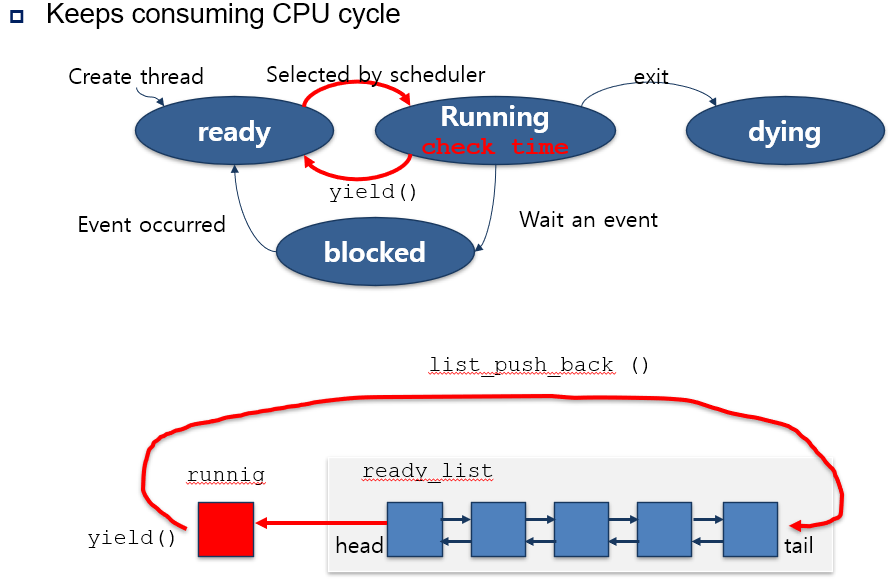
문제점은 다음과 같다.
- CPU 낭비: 실제로는 ‘기다리기만’ 하면서 CPU를 100% 사용
- 다른 작업 불가: 기다리는 동안 다른 프로세스·스레드를 수행할 수 없음
- 에너지 비효율: 특히 모바일·서버 환경에서 불필요한 전력 소모
1-2. 해결책: Blocking (Sleep/Wakeup)
OS는 busy waiting 대신 Blocking(Sleep) 기법을 쓴다. 기다릴 일이 생기면 CPU를 반납하고 Sleep 상태로 들어가며, 이벤트가 발생하면 OS가 다시 깨운다(Wakeup). 이를 Interrupt-driven 방식이라고도 한다.
| 항목 | Busy Waiting | Blocking |
|---|---|---|
| CPU 사용 | 기다리는 동안 100% | 기다릴 때 0% (다른 작업 실행) |
| 응답성 | 나쁨 (CPU 계속 점유) | 좋음 (필요할 때만 점유) |
| 에너지 소모 | 높음 | 낮음 |
| 시스템 처리량 | 낮음 | 높음 |
예를 들어 100개의 프로세스가 어떤 이벤트를 기다린다고 하자. Busy waiting이면 100개 모두 CPU를 쓰려 해 CPU가 1개면 다른 일을 전혀 못 한다. Blocking이면 99개는 잠자고 필요한 프로세스만 CPU를 쓰므로, CPU가 다른 요청도 병행 처리할 수 있다.
1-3. Sleep/Wakeup 구조 설계
sleep_list를 만들어 wakeup_tick(alarm 시간)만큼 재울 thread를 넣고, wakeup_tick에 도달하면 ready_list로 옮기는 구조로 바꾼다.
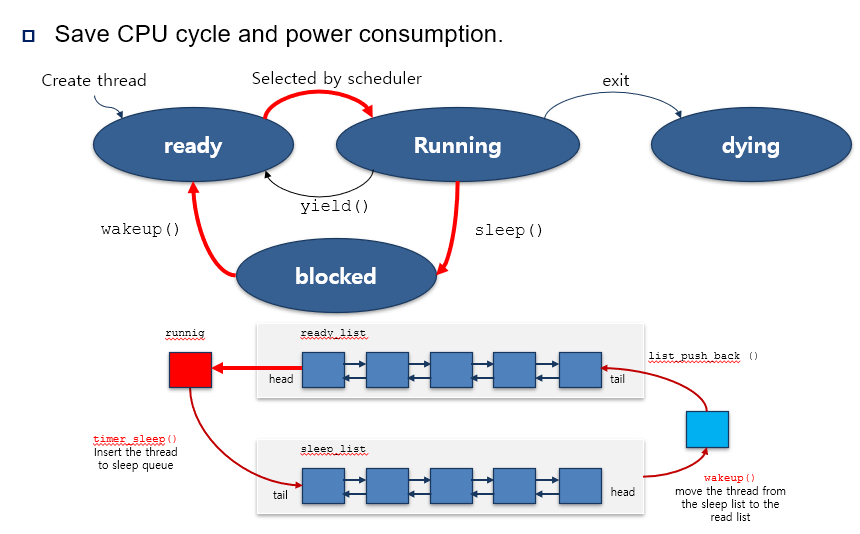
먼저 sleep_list를 ready_list와 함께 선언하고, global_tick(sleep_list의 최소 wakeup_tick)을 선언한다. global_tick을 INT64_MAX로 초기화하는 이유는, sleep_list가 비었을 때 깨울 thread 확인 작업에 들어가지 않게 하기 위함이다.
static int64_t global_tick = INT64_MAX;

static struct list ready_list;
static struct list sleep_list;
thread_init에서 sleep_list를 초기화한다.
void
thread_init (void) {
	ASSERT (intr_get_level () == INTR_OFF);

	struct desc_ptr gdt_ds = { // x86 세그먼트 테이블 정의
		.size = sizeof (gdt) - 1,
		.address = (uint64_t) gdt
	};
	lgdt (&gdt_ds);

	/* Init the global thread context */
	lock_init (&tid_lock);          // 스레드 tid 할당 락
	list_init (&ready_list);        // ready 리스트
	list_init (&sleep_list);        // sleep 리스트
	list_init (&destruction_req);   // 삭제 예약된 스레드 리스트

	/* Set up a thread structure for the running thread. */
	initial_thread = running_thread ();
	init_thread (initial_thread, "main", PRI_DEFAULT);
	initial_thread->status = THREAD_RUNNING;
	initial_thread->tid = allocate_tid ();
}
깨울 기준이 되는 wakeup_tick을 struct thread에 추가한다.
struct thread {
	tid_t tid;                    /* Thread identifier. */
	enum thread_status status;    /* Thread state. */
	char name[16];                /* Name (for debugging). */
	int64_t wakeup_tick;          // 깨울 시간
	int priority;                 /* Priority. */
	int original_priority;
	struct list donations;
	struct list_elem d_elem;
	struct lock *wait_on_lock;

	struct list_elem elem;        /* List element. */
};
1-4. timer_sleep과 thread_sleep 수정
timer_sleep에서 busy waiting(thread_yield 루프)을 thread_sleep 호출로 바꾼다.
void
timer_sleep (int64_t ticks) {
	int64_t start = timer_ticks ();

	ASSERT (intr_get_level () == INTR_ON);
	if (timer_elapsed(start) < ticks)
		thread_sleep(start + ticks);
}
thread_sleep은 wakeup_tick을 저장하고 sleep_list에 정렬 삽입(깨울 시간이 임박한 것이 앞에 오도록)한 뒤, update_global_tick으로 global_tick을 최소값으로 갱신하고 block한다.
void
thread_sleep(int64_t ticks){
	if (thread_current() != idle_thread){
		enum intr_level old_level = intr_disable();
		struct thread *cur = thread_current();
		cur->wakeup_tick = ticks;

		list_insert_ordered(&sleep_list, &cur->elem, cmp_wakeup_tick, NULL); // 정렬 삽입
		update_global_tick();   // global tick 갱신
		thread_block();         // block 상태로 변경
		intr_set_level(old_level);
	}
}

static bool // 깨어날 순으로 오름차순 정렬
cmp_wakeup_tick(const struct list_elem *a_, const struct list_elem *b_, void *aux UNUSED){
	struct thread *a = list_entry(a_, struct thread, elem);
	struct thread *b = list_entry(b_, struct thread, elem);
	return a->wakeup_tick < b->wakeup_tick;
}

static void update_global_tick() { // global_tick을 최소값으로 갱신
	if (!list_empty(&sleep_list)){
		struct thread *a = list_entry(list_front(&sleep_list), struct thread, elem);
		global_tick = a->wakeup_tick;
	}
	else{
		global_tick = INT64_MAX;
	}
}
1-5. timer_interrupt에서 깨우기
timer_interrupt에서 check_global_tick으로 깨울 시간이 됐는지 확인하고, 됐다면 wakeup_thread를 실행한다.
/* Timer interrupt handler. */
static void
timer_interrupt (struct intr_frame *args UNUSED) {
	ticks++;
	thread_tick (); // running 스레드의 CPU 사용량 업데이트
	if (check_global_tick(ticks))
		wakeup_thread (ticks); // 깨울 스레드 찾아가기
}

bool
check_global_tick(int64_t ticks){
	return ticks >= global_tick;
}

void
wakeup_thread (int64_t target_ticks){
	while (!list_empty(&sleep_list)) {
		struct list_elem *target_ele = list_front(&sleep_list);
		struct thread *target = list_entry(target_ele, struct thread, elem);

		if (target->wakeup_tick <= target_ticks) {
			list_remove(target_ele);
			thread_unblock(target);
		} else {
			break; // 정렬돼 있으므로 더 볼 필요 없음
		}
	}
	update_global_tick(); // 갱신
}
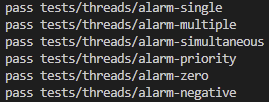
이렇게 수정하면 아래와 같은 결과가 나온다.
2. Priority Scheduling — Preemption과 Donation
2-1. Preemption이란?
선취권이라는 뜻으로, ready_list에 thread가 들어갈 때 현재 running thread와 priority를 비교해, 새 thread가 더 높으면 running thread를 재우고 ready_list의 최고 우선순위 thread를 실행하는 것이다.
2-2. Preemption 구현
thread_create에서 thread를 ready_list에 넣은 뒤 thread_ready_check로, 현재 thread와 새 thread의 priority를 비교해 조건에 따라 thread_yield한다.
tid_t
thread_create (const char *name, int priority,
		thread_func *function, void *aux) {
	struct thread *t;
	tid_t tid;

	ASSERT (function != NULL);

	t = palloc_get_page (PAL_ZERO);
	if (t == NULL)
		return TID_ERROR;

	init_thread (t, name, priority);
	tid = t->tid = allocate_tid ();

	t->tf.rip = (uintptr_t) kernel_thread;
	t->tf.R.rdi = (uint64_t) function;
	t->tf.R.rsi = (uint64_t) aux;
	t->tf.ds = SEL_KDSEG;
	t->tf.es = SEL_KDSEG;
	t->tf.ss = SEL_KDSEG;
	t->tf.cs = SEL_KCSEG;
	t->tf.eflags = FLAG_IF;

	thread_unblock (t);
	thread_ready_check(t);
	return tid;
}

void
thread_ready_check (struct thread *t){
	if ((thread_current() != idle_thread) && thread_current ()->priority < t->priority)
		thread_yield();
}
thread_unblock은 priority 기준 정렬 삽입으로 수정한다.
void
thread_unblock (struct thread *t) {
	enum intr_level old_level;

	ASSERT (is_thread (t));

	old_level = intr_disable ();
	ASSERT (t->status == THREAD_BLOCKED);
	list_insert_ordered (&ready_list, &t->elem, cmp_priority, NULL);
	t->status = THREAD_READY;
	intr_set_level (old_level);
}
thread_yield도 마찬가지로 정렬 삽입한다.
void
thread_yield (void) {
	struct thread *curr = thread_current ();
	enum intr_level old_level;

	ASSERT (!intr_context ());

	old_level = intr_disable ();
	if (curr != idle_thread)
		list_insert_ordered (&ready_list, &curr->elem, cmp_priority, NULL);
	do_schedule (THREAD_READY);
	intr_set_level (old_level);
}
thread_set_priority는 running thread의 priority가 ready_list 최대 priority보다 낮아지면 preemption되도록 thread_ready_check를 추가한다.
/* Sets the current thread's priority to NEW_PRIORITY. */
void
thread_set_priority (int new_priority) {
	thread_current ()->priority = new_priority;
	if (!list_empty(&ready_list))
		thread_ready_check(list_entry(list_front(&ready_list), struct thread, elem));
}
이 3개 함수를 고치면 preemption 구현은 완료다.
2-3. 동기화와 Donation 개념
semaphore, condition variable, lock의 개념은 동기화 기법 3대장에, Donation의 개념은 Donation에 정리해두었다. 여기서 구현할 Donation의 세 가지 경우는 다음과 같다.
| 종류 | 상황 | 원리 |
|---|---|---|
| One Donation | lock의 waiter 리스트가 있을 때 | waiter 중 가장 높은 priority로 donation |
| Nested Donation | lock을 가진 thread가 또 다른 lock의 waiter일 때 | 가장 높은 priority 기준으로 요청 중인 lock 쪽으로 연쇄 donation |
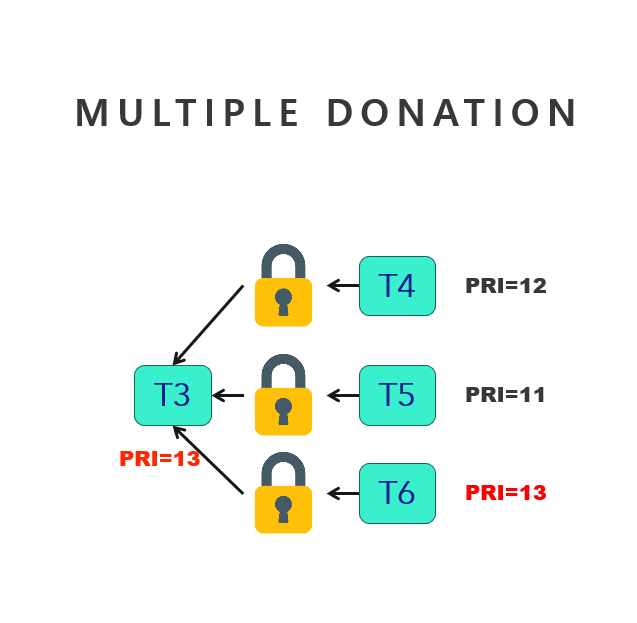
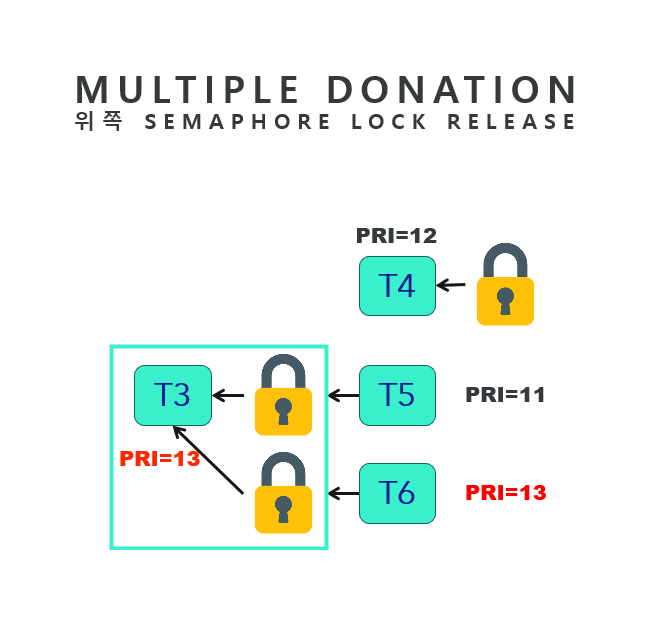
| Multiple Donation | 하나의 thread가 여러 lock을 가질 때 | 모든 lock의 waiter 중 가장 높은 priority로 donation |
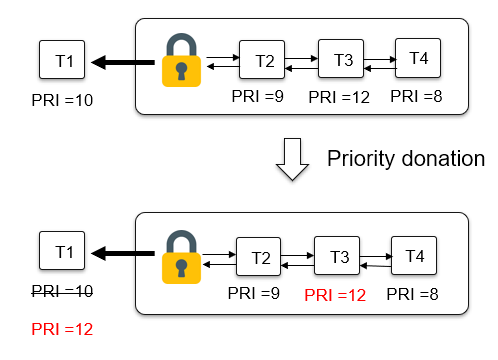
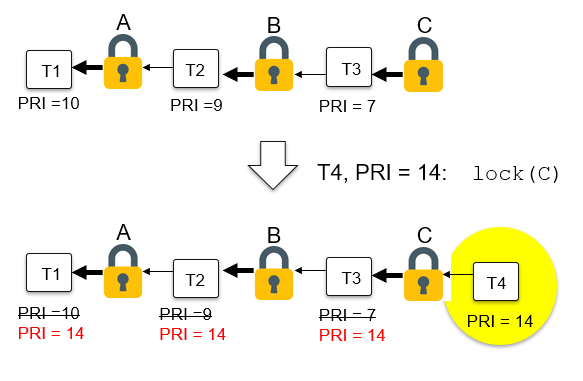
Multiple Donation에서 가장 높은 priority를 내준 thread에게 lock 권한을 넘기면, 아래 사진 기준 T1은 T4보다 낮은(나머지 중 최고) priority를 갖게 되고 일할 권한은 T4가 가진다.
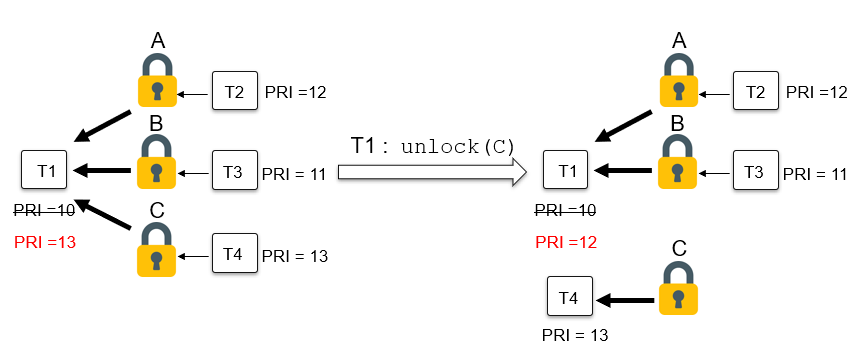
다른 예로, T3가 T4에게 lock을 넘긴 뒤를 보면, T3의 priority가 계속 높아 T4는 아직 일하지 못한다. T3가 (T6가 요청한) lock을 넘기고 T6가 모든 일을 마쳐야만 T4가 일할 수 있다.
2-4. Donation 구현
struct thread에 donation 관련 필드를 추가한다. donations 리스트, 거기에 넣을 d_elem, 기다리는 lock을 명시할 *wait_on_lock, 그리고 priority가 변했다가 복원되도록 original_priority를 둔다.
struct thread {
	tid_t tid;
	enum thread_status status;
	char name[16];
	int64_t wakeup_tick;          // 깨울 시간
	int priority;
	int original_priority;
	struct list donations;
	struct list_elem d_elem;
	struct lock *wait_on_lock;

	struct list_elem elem;
}
init_thread에서 donations 리스트를 초기화하고 original_priority를 저장한다.
static void
init_thread (struct thread *t, const char *name, int priority) {
	ASSERT (t != NULL);
	ASSERT (PRI_MIN <= priority && priority <= PRI_MAX);
	ASSERT (name != NULL);

	memset (t, 0, sizeof *t);
	t->status = THREAD_BLOCKED;
	strlcpy (t->name, name, sizeof t->name);
	t->tf.rsp = (uint64_t) t + PGSIZE - sizeof (void *);
	t->priority = priority;
	t->magic = THREAD_MAGIC;
	list_init (&(t->donations)); // donations 리스트
	t->original_priority = priority;
}
이제 핵심부다. Multiple과 Nested donation이 함께 나온다. lock_acquire에서 lock->holder가 있으면 donation이 가능하도록 mult_donation을 실행한다(One donation 기능 포함). mult_donation은 각 lock에 대해 priority가 최대인 thread의 d_elem이 donations 리스트에 들어가게 하고, 끝날 때쯤 조건부로 nested_donation을 부른다.
void
lock_acquire (struct lock *lock) {
	ASSERT (lock != NULL);
	ASSERT (!intr_context ());
	ASSERT (!lock_held_by_current_thread (lock));

	if (lock->holder != NULL)
	{
		mult_donation(lock);
	}

	sema_down (&lock->semaphore);
	lock->holder = thread_current ();
	thread_current()->wait_on_lock = NULL;
}

void
mult_donation(struct lock *lock)
{
	struct thread *lock_holder = lock->holder;
	enum intr_level old_level;

	ASSERT (!intr_context ());
	old_level = intr_disable ();

	thread_current()->wait_on_lock = lock;
	if (list_empty(&lock->semaphore.waiters))
		list_insert_ordered(&lock_holder->donations, &thread_current()->d_elem, cmp_priority_d_elem, NULL);
	else
	{
		struct list_elem *elem = list_begin(&lock->semaphore.waiters);
		struct thread *thread = list_entry(elem, struct thread, elem);
		if (thread->priority < thread_current()->priority)
		{
			list_remove(&thread->d_elem);
			list_insert_ordered(&lock_holder->donations, &thread_current()->d_elem, cmp_priority_d_elem, NULL);
		}
	}

	if (lock_holder->priority < thread_current()->priority)
	{
		lock_holder->priority = thread_current()->priority;

		if (lock_holder->wait_on_lock != NULL)
			nested_donation(lock_holder->wait_on_lock);
	}
	intr_set_level (old_level);
}

void
nested_donation (struct lock *lock)
{
	if (lock->holder != NULL)
	{
		if (lock->holder->priority < thread_current()->priority)
		{
			lock->holder->priority = thread_current()->priority;

			if(lock->holder->wait_on_lock != NULL)
				nested_donation(lock->holder->wait_on_lock);
		}
	}
}
lock_release에서는 donations 리스트가 비었으면 original_priority로 복원하고, 있으면 해제하는 lock의 waiter를 donations에서 빼준 뒤 자신의 priority를 (original과 donation 최대값 중 큰 쪽으로) 맞춘다.
void
lock_release (struct lock *lock) {
	ASSERT (lock != NULL);
	ASSERT (lock_held_by_current_thread (lock));

	if (list_empty(&lock->holder->donations))
	{
		thread_current()->priority = thread_current()->original_priority;
	}
	else
	{
		enum intr_level old_level;
		ASSERT (!intr_context ());
		old_level = intr_disable ();

		if (!list_empty(&lock->semaphore.waiters))
		{
			struct list_elem *elem = list_begin(&lock->semaphore.waiters);
			struct thread *thread = list_entry(elem, struct thread, elem);
			list_remove(&thread->d_elem);
		}
		struct list_elem *donation_elem = list_max(&thread_current()->donations, cmp_priority, NULL);
		int donation_max = list_entry(donation_elem, struct thread, d_elem)->priority;

		if (thread_current()->original_priority > donation_max)
			thread_current()->priority = thread_current()->original_priority;
		else
			thread_current()->priority = donation_max;

		intr_set_level (old_level);
	}

	lock->holder = NULL;
	sema_up (&lock->semaphore);
}
마지막으로 도중에 priority를 바꾸는 thread_set_priority도 donation을 고려해 수정한다. donation을 받은 상태라면 original_priority만 갱신하고 현재 priority는 유지해야 한다.
void
thread_set_priority (int new_priority)
{
	thread_current ()->original_priority = new_priority;
	if (new_priority > thread_current()->priority)
		thread_current()->priority = new_priority;
	else if(list_empty(&thread_current()->donations)){
		thread_current()->priority = new_priority;
	}
	if (!list_empty(&ready_list))
		thread_ready_check(list_entry(list_front(&ready_list), struct thread, elem));
}
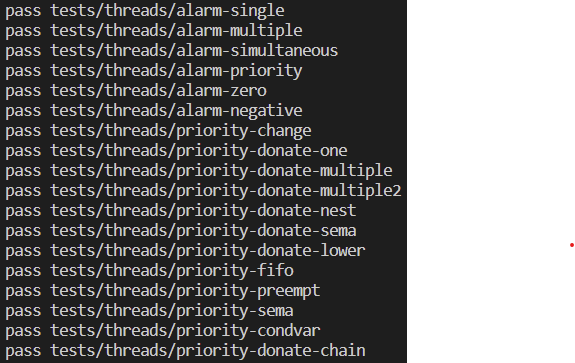
여기까지 구현하면 아래와 같은 결과를 볼 수 있다.
3. 주의사항
- list에 변경 작업이 있을 때는 interrupt를 끄고, 작업 후 다시 켜는 것이 좋다.